

You’ve already decided the old line has to go. That decision — repair, retrofit, or replace — is behind you. Now comes the harder one: do you buy a standard, catalog-configured conveyor, or do you engineer something custom to your line?
It’s a decision plant managers and engineers get wrong in both directions. Buy standard when the application actually needs custom engineering, and you’re retrofitting again in eighteen months. Commission a fully custom system for an application a standard platform already solves, and you’ve paid more, waited longer, and added complexity you didn’t need.
Standard vs. Custom: Two Different Starting Points
The terms describe where the design work starts, not how good the outcome is:
- Standard conveyors are built from a proven, configurable platform — established frame widths, drive options, and belt styles that cover the large majority of product-handling applications without new engineering.
- Custom conveyors start from your application’s constraints — product geometry, throughput target, plant layout, integration points — and the system is engineered around them from the ground up.
Neither is the “upgrade” version of the other. A well-matched standard platform outperforms an over-engineered custom build the same way a poorly scoped custom build outperforms a standard platform stretched past its design intent.
A Simple Decision Framework
Before requesting quotes, work through these questions:
- Product Variability: Does the line run one product family in a consistent size/weight range, or does it need to flex across multiple SKUs, packaging formats, or future product lines?
- Floor Plan Constraints: Does the conveyor need to fit an existing footprint with fixed columns, low clearances, or awkward transitions — or is the layout being built around the equipment?
- Integration Requirements: Does the system need to talk to robotics, vision systems, AGVs, or existing controls architecture, or does it run as a standalone product-handling segment?
- Throughput and Duty Cycle: Is the target speed and cycle rate within what a standard platform is rated for, or does it exceed catalog specifications?
- Regulatory and Sanitation Requirements: Does the application need 3-A, USDA, or other hygienic-design compliance built into the frame and belt geometry, not added after the fact?
- Timeline and Budget Sensitivity: Is fast turnaround the priority, or is there room to invest in engineering time for a system built to last multiple product generations?
Most buyers find three or four of these point clearly in one direction. When the answers split, that’s usually the sign the application sits in a gray zone worth a direct conversation with an applications engineer before committing either way.
When Standard Is the Smarter Choice
Standard platforms are the right call more often than buyers assume, particularly for applications with well-understood product handling needs. If your product size and weight fall within common ranges, your floor plan has reasonable flexibility, and you’re not integrating exotic automation, a configurable platform gets you a proven, supportable system faster and at lower cost.
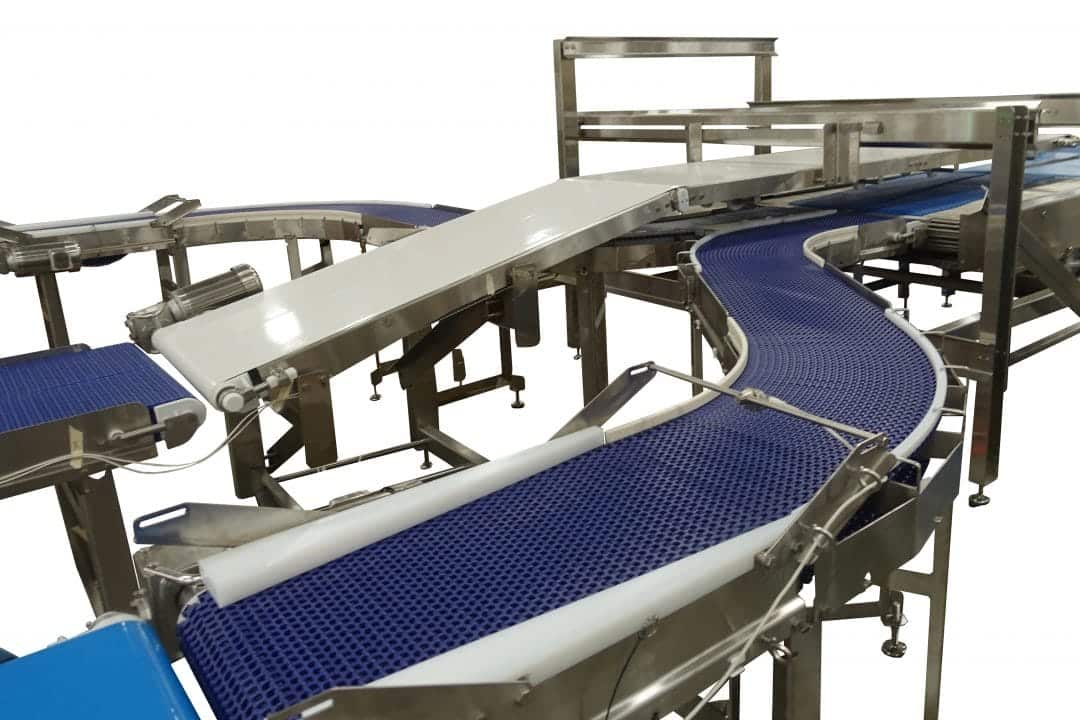
Modular platforms like FlexMove narrow the gap between standard and custom further — curves, inclines, transfers, and length changes are configuration decisions, not new engineering projects. That flexibility means “standard” doesn’t have to mean rigid or generic; it means built from modular parts and processes that are already proven.
The clearest sign standard is the right fit: your team can describe the application in a single sentence — “move 40-pound cases at 60 FPM from packing to palletizing” — without a list of exceptions.
When Custom Is the Better Investment
Custom engineering earns its cost when the application has constraints a catalog platform wasn’t designed around:
- Non-standard product geometry, weight distribution, or handling requirements that would force compromises on a standard frame
- Tight or irregular floor space where the conveyor has to be designed around the room, not the other way around
- Deep integration with robotics, AMRs, vision inspection, or existing plant controls where the conveyor is one component in a larger automated cell
- Sanitary or regulatory requirements where hygienic design has to be structural — frame geometry, belt access, wash-down tolerance — not retrofitted
- Throughput or duty-cycle targets that exceed what a standard platform is rated to sustain without accelerated wear
In these cases, the Engineered Solutions Group builds from the application backward — mechanical, electrical, and controls engineering working from your product and layout, not a catalog sheet. That’s a longer lead time than ordering a standard system, but it solves the actual problem instead of managing around it for the life of the line.
How Floor Space, Sanitation, and Automation Change the Answer
Floor Space: A standard platform assumes reasonably conventional runs, transitions, and clearances. If your plant has legacy columns, low ceilings, or a footprint that wasn’t designed with conveyance in mind, a custom systems approach — engineered to the room rather than fit into it — usually saves more in installation and rework than it costs upfront.
Sanitation: Food, beverage, and pharmaceutical operations should treat hygienic design as a structural question, not a components question. A standard non-sanitary frame can’t be upgraded to hygienic-grade after the fact, but that doesn’t mean you need a fully custom build. Dorner’s AquaPruf and AquaGard lines are standard platforms built to meet sanitary and washdown requirements, with hygienic frame geometry and belt access designed in from the start. Lead times run longer than on the 2200 or 3200 Series, but they’re still much shorter than a heavily engineered custom system.
Automation Integration: If robotics, AMRs, or vision systems are part of the line now — or realistically within the next few years — build that into the decision today. A standard industrial conveyor can often integrate cleanly with controlled automation if the interfaces are specified up front; retrofitting automation compatibility onto an already-installed standard system later is where projects lose time and budget.
What to Ask Your Conveyor Partner Before Committing
- Does our product geometry, weight, or handling requirement fall inside your standard platform’s rated specifications, or outside them?
- If we go standard now, what happens if our product mix or volume changes in the next three to five years?
- Does our hygienic or regulatory requirement call for a fully custom build, or can a standard sanitary platform meet it out of the box?
- How does lead time compare between a configured standard system and a fully engineered custom build for this specific application?
- If we’re integrating robotics or automation later, what needs to be specified now to avoid a rebuild?
A partner who can answer these directly — and who’s willing to recommend standard when standard is the better fit — is one worth trusting with the custom call too.
Frequently Asked Questions
Is a custom conveyor always better than a standard one?
No. Custom engineering solves problems a standard platform can’t — but it costs more and takes longer to build. If your application fits within a standard platform’s specifications, custom adds cost and lead time without a corresponding benefit.
How much longer does a custom conveyor take to design and build compared to standard?
It varies by application complexity, but custom systems generally require dedicated engineering time upfront that configured standard systems don’t. Discussing realistic timelines early avoids surprises against a production start date.
Can a standard conveyor be modified later if our needs change?
Sometimes — modular platforms in particular are designed for reconfiguration. But changes that involve frame geometry, significant automation integration, or major throughput increases usually point back toward a custom or engineered solution rather than a modification.
Does choosing custom mean we lose the reliability of a proven platform?
Not with the right partner. Custom-engineered systems should still draw on proven components and manufacturing standards — the customization is in how those components are configured and integrated, not a departure from reliability.
What’s the first step if we’re not sure which way to go?
Bring your product specifications, floor plan constraints, and any automation or compliance requirements to an applications engineer before requesting quotes. A short scoping conversation upfront is far cheaper than correcting the wrong choice after installation.
Ready to Scope Your Line the Right Way?
Standard or custom isn’t a preference — it’s a conclusion you reach by working through your product, your floor plan, and your growth plans. Dorner’s team can help you get to the right answer before you commit to either.